
Frozen Shoulder (Adhesive Capsulitis)
Guided Injections.
Frozen shoulder: what is it?
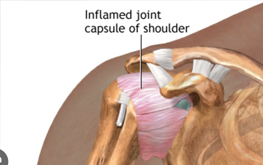
Frozen shoulder, or adhesive capsulitis, is a condition characterised by progressive pain and restricted movement of the shoulder joint. It results from inflammation and fibrosis of the joint capsule, leading to decreased range of motion. The condition typically progresses through three stages: the freezing (painful) phase, the frozen (stiffness) phase, and the thawing (recovery) phase.
Which symptoms are typical of frozen shoulder?
- Shoulder discomfort and stiffness that gradually develop, particularly at night.
- Considerable reduction in range of motion, both passive and active.
- Difficulty with tasks, including sleeping, dressing, and reaching aloft.
A dull, aching pain that may extend into the upper arm. Limited shoulder external rotation, which is frequently the movement most impacted (NICE Guidelines, 2023).
How Do You Diagnose Frozen Shoulder?
A physiotherapist will do a thorough evaluation that includes:
- Physical examination: Evaluating range of motion, stiffness, and pain.
- Palpation and movement tests: Using both passive and vigorous movements to detect pain.
- Imaging (if necessary): ultrasound to rule out other disorders, such as osteoarthritis, bursitis, or rotator cuff tears.
What Can We Expect Following an Injection?
- Mild discomfort for 24 to 48 hours at the injection location.
- Depending on the type of injection, pain relief could start in a matter of days or weeks.
- After an injection, physiotherapy is advised to preserve joint function and mobility.
- Although it varies, complete healing usually takes many months.
Are there Risks?
- The chance of infection is extremely low—roughly 1 in 50,000 cases.
- A post-injection flare, or brief increase in pain, may happen but goes away in a few days.
- Blood sugar levels may temporarily rise with corticosteroids, especially in people with diabetes.
- Under ultrasound guidance, the uncommon danger of nerve damage or joint haemorrhage is reduced (NICE Guidelines, 2023).
Consult your Healthcare professional to find out if injectable therapy is the best course of action for you if you have chronic shoulder pain and stiffness.
Treatment options
Guided Corticosteroid Injections
For persistent pain, corticosteroid injections may be recommended to reduce inflammation and provide short-term relief.
Guided Hyaluronic Acid Injections
Hyaluronic acid (HA) injections guided by ultrasound scans are a state-of-the-art treatment for osteoarthritis, cartilage degradation, and joint pain at MSK Clinic Physio.
Your Clinician


BSc Physiotherapy MSCP (Hons)
PGCert Independent Medical Prescriber
PGCert Soft Tissue and Joint Injection Therapist
PGCert Diagnostic Ultrasound
References
Date, A., & Rahman, L. (2020). Frozen shoulder: overview of clinical presentation and review of the current evidence base for management strategies. Future science OA, 6(10), FSO647
Liang, C. W., Cheng, H. Y., Lee, Y. H., Liao, C. D., & Huang, S. W. (2024). Corticosteroid Injection Methods for Frozen Shoulder: A Network Meta-analysis. Archives of Physical Medicine and Rehabilitation.
Mao, B., Peng, R., Zhang, Z., Zhang, K., Li, J., & Fu, W. (2022). The effect of intra-articular injection of hyaluronic acid in frozen shoulder: a systematic review and meta-analysis of randomized controlled trials. Journal of Orthopaedic Surgery and Research, 17(1), 128
NICE Guidelines (2023). Management and Treatment of Frozen Shoulder.
Poku, D., Hassan, R., Migliorini, F., & Maffulli, N. (2023). Efficacy of hydrodilatation in frozen shoulder: a systematic review and meta-analysis. British Medical Bulletin, 147(1), 121-147
Sun, Y., Zhang, P., Liu, S., Li, H., Jiang, J., Chen, S., & Chen, J. (2017). Intra-articular steroid injection for frozen shoulder: a systematic review and meta-analysis of randomized controlled trials with trial sequential analysis. The American journal of sports medicine, 45(9), 2171-2179.