
Knee Anatomy
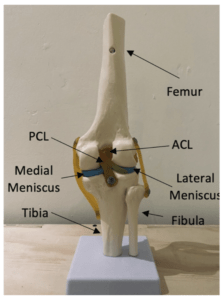
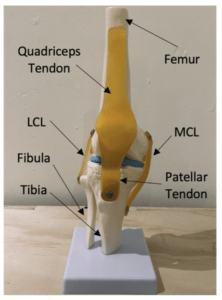
The knee consists of two joints, four ligaments and supporting structures.
Joints
- Tibiofemoral joint: tibia (shin bone) and femur (thigh bone)
- Patellofemoral joint: patella (kneecap) and femur (thigh bone)
Ligaments
- Anterior cruciate ligament (ACL)
- Posterior cruciate ligament (PCL)
- Medial collateral ligament (MCL)
- Lateral collateral ligament (LCL)
Supporting Structures
- Menisci (medial meniscus, lateral meniscus)
- Articular cartilage
- Tendons (patellar tendon, quadriceps tendon)
- Muscles (such as: hamstrings, quadriceps)
Knee Pain
The common pathologies that can cause knee pain can be separated into two categories: traumatic and non-traumatic injuries. Traumatic knee injuries often occur during sports and have a sudden mechanism of injury. Non-traumatic injuries often occur through mechanical overuse and have an insidious onset.
Common Traumatic Knee Injuries
- Ligament (ACL, MCL, PCL, LCL) sprain/rupture
- Meniscus tear
- Patella dislocation
Common Non-Traumatic Knee Injuries
- Patellofemoral Pain Syndrome (PFPS)
- Patellar Tendinopathy
- Iliotibial Band (ITB) Syndrome
- Osteoarthritis (OA) and degenerative meniscus
Your physiotherapist can complete a comprehensive subjective assessment followed by appropriate special tests to diagnose your injury.
Knee ligament sprain/rupture
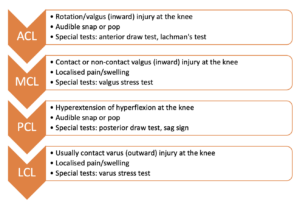
Knee ligament injuries usually occur during sports, this can be either through a contact or non-contact injury. Sports involving multidirectional movement such as football and basketball are at a higher risk.
Meniscus injury
Meniscus injuries can occur through trauma or degenerative overuse. Traumatic meniscus injuries have a similar mechanism of injury to ACL injuries, often occurring when an individual is twisting/turning with their knees flexed and foot planted. Often there will be a trial of conservative management, with the aid of a physiotherapist, and an option for surgery if there is an acute tear or persistent pain.
Patella dislocation
Patella dislocations occur when the patella (kneecap) is out of place. This can occur through two mechanisms. Firstly, high impact trauma through a normal knee. Secondly, low impact trauma through a hypermobile or previously injured knee.
Patellofemoral pain syndrome (PFPS)
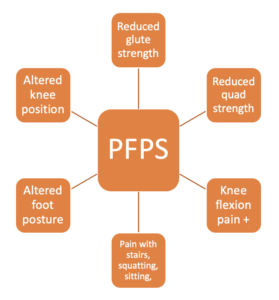
PFPS is defined as pain in the anterior (front) aspect of the knee due to suboptimal biomechanics and/or strength.
Patellar Tendinopathy
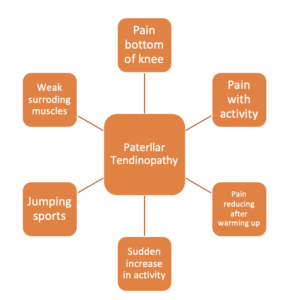
Patellar tendinopathy is an overuse injury effecting the patella tendon running from the patella (kneecap) to the tibial tuberosity (upper shin). Pain is often localised to the lower part of the patella. There is often no pain at rest but pain with increased load on the knees.
Iliotibial Band (ITB) Syndrome
The ITB is a thick band of fascia running along the outside of the thigh. ITB syndrome refers to the condition that irritates the ITB at its insertion on the outside of the knee.

Knee Osteoarthritis (OA)
Osteoarthritis refers to the progressive degenerative joint disease where the cartilage between bones, such as the knee, is reduced. According to the National Institute for Health and Care Excellence (NICE) guidelines, an OA diagnosis without imaging can be made by your healthcare professional if:
- Age >45 and
- Activity related joint pain and
- No early morning stiffness (EMS) or EMS <30 minutes
The management of OA requires a holistic approach with advice from a healthcare professional.