
Hallux rigidus
Guided Injections.
What is hallux rigidus?
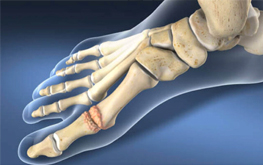
Hallux rigidus is another name for the stiffness of the big toe due to osteoarthritis. This occurs when cartilage and joint space are lost, narrowing the metacarpophalangeal joint, as shown in the photo above. Osteoarthritis can also occur in toes 2-5, but this is less common. This is because the big toe bears most of your weight during the push-off phase when walking and running. This joint is also responsible for keeping you balanced during weight-bearing activities, maintaining normal alignment and stability of the foot, gripping the ground to control your movements, and absorbing shock. (Senga et al., 2021)
What are the common symptoms of this?
- Stiffness and reduced extension range of motion in the big toe
- Pain, tenderness, and swelling around the joint
- Difficulty walking, especially when pushing off the toe
- Bony bumps around the joint – (Ying et al., 2021)
How is this diagnosed?
To assess your condition, your physiotherapist will ask about your symptoms and conduct a physical examination, looking for the following:
- Reduced range of motion and stiffness of the big toe joint
- Any signs of pain or inflammation in the affected area
- Bony growths and incongruity of the big toe joint
- Weakness in the surrounding musculature
- Difficulty with weight-bearing and abnormal gait pattern
Your physiotherapist may also recommend imaging tests, such as X-rays, to check for the integrity of the joint surfaces, joint space narrowing, bone growths, and other bone changes
Treatment options
Guided Corticosteroid Injections
For persistent pain, corticosteroid injections may be recommended to reduce inflammation and provide short-term relief.
Guided Hyaluronic Acid Injections
Hyaluronic acid (HA) injections guided by ultrasound scans are a state-of-the-art treatment for osteoarthritis, cartilage degradation, and joint pain at MSK Clinic Physio.
Your Clinician


BSc Physiotherapy MSCP (Hons)
PGCert Independent Medical Prescriber
PGCert Soft Tissue and Joint Injection Therapist
PGCert Diagnostic Ultrasound
Senga, Y., Nishimura, A., Ito, N., Kitaura, Y., & Sudo, A. (2021). Prevalence of and risk factors for hallux rigidus: a cross-sectional study in Japan. BMC musculoskeletal disorders, 22, 1-7.
Ying, J., Xu, Y., István, B., & Ren, F. (2021). Adjusted indirect and mixed comparisons of conservative treatments for Hallux valgus: a systematic review and network meta-analysis. International Journal of Environmental Research and Public Health, 18(7), 3841.