
Achilles Heel
Pain on the back of the heel or just above the back of the heel is referred to as Achilles tendinopathy. Achilles tendinopathy is a continuum of symptoms ranging from inflammatory pathology to degenerative changes. This article discusses the main two types of issues causing posterior heel pain. Achilles tendinopathy is characterised by pain and loss of ability to walk, such as jumping.

Mid-portion tendinopathy is pain or changes of the tendon located at the mid portion of the tendon (a little above the heel), and insertional Achilles tendinopathy is pain where the Achilles tendon inserts onto the heel.
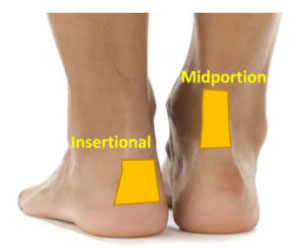
Achilles Tendinopathy is a widespread injury among people who run or participate in running-related sports, such as football and in people who are sedentary. Mid-portion Achilles issues are more common than insertional Achilles issues.
Some risk factors for the development of tendinopathy include intrinsic and extrinsic risk factors. The inherent risk factors include training in cold weather, taking some antibiotics, moderate alcohol use, and decreased plantar flexor strength. Some extrinsic risk factors include a rapid increase in training load, a period of inactivity followed by a return to sport, or poor recovery and high stress.
How long does it take to heal?
Achilles tendon issues can take some time to resolve. It can take between 12 and 52 weeks, and symptoms can persist for years after the development of problems.
How does it get diagnosed?
Your physio can diagnose if you have Achilles tendon issues. This is achieved by taking a detailed history of your problems, followed by a clinical assessment. Most patients report a change in their loading history around the onset of their symptoms. Morning stiffness in the Achilles tendon and pain after sitting for an extended period are characteristic of Achilles tendon issues, and easing symptoms after walking or running. As the injury progresses, patients may complain of worsening symptoms for 1-2 days following a bout of exercise.
Ultrasound Scan
At MSK Clinic Physio, we use ultrasound scans to help diagnose Achilles tendon issues. With ultrasound imaging, you can see the tendon and the surrounding tissues, helping identify where the problem is, and this can help with the clinical examination findings to devise an appropriate management plan tailored to your injury.

What treatment helps?
Education and advice
Tendons do not respond well to rest despite reducing pain. This will not improve the loading capacity of the tendon and may contribute to persistent symptoms. Physios rarely advise rest for the management of tendon issues unless specifically advised to do so. Pain management is critical, and it is essential to work with your physio to understand how to build up strength without aggravating your symptoms further.
It can take from 6-12 months for symptoms to resolve, and sometimes, it is hard to stay motivated to continue with your rehab. Still, it is essential that even after your symptoms resolve, you continue with your rehab. It is necessary to set goals, which will be done in collaboration with your physiotherapist to ensure your rehabilitation is tailored to achieving them.
Flare-ups in your symptoms are a normal part of the rehabilitation process, and this is to be expected, especially in the early stages, as your physiotherapist is trying to determine your current loading capacity. With tendon injuries, it’s possible to overdo the rehabilitation slightly, which can also be influenced by other factors such as poor recovery, stress, and diet. Your physiotherapist will guide you through flare-ups and help you overcome the ups and downs typically experienced during tendon rehabilitation.
Education and advice have been advocated in the research for managing mid-portion Achilles tendinopathy (Malliaras, 2022). The primary focus would be facilitating self-management and self-efficacy in concurrence with clinical practice guidelines (Martin et al., 2018). Patients can adopt a ‘boom-bust’ strategy. This can be addressed with education and advice about how, primarily, tendinopathy is an overloading issue, a discussion about load management and activity modification, and education can be given to address maladaptive beliefs commonly held by patients with Achilles tendinopathy (Turner et al., 2020). Sometimes, patients have fear-based beliefs that activity would worsen their condition so that a physio might spend some time on gradual activity exposure and pain education (Malliaras, 2022). A recent study also highlighted a high prevalence of fear avoidance and kinesiophobia in patients with Achilles tendinopathy (Smitheman et al., 2023). When treating this patient group, it may be helpful to consider and address the psychological and personal impact of this disorder (McAuliffe et al., 2017).
Exercise
Strengthening the tendon and improving its loading capacity are very important when reviewing the research on tendon management. Your physiotherapist will assess your current ability and build from there.
Several trials advocate exercise-based interventions for managing mid-portion Achilles tendinopathy. The most referenced exercise protocols include the Afredson eccentric program, the heavy, slow resistance program and the Silbernagel program (Milliaras, 2022). There is heterogeneity in the research on the optimal type of exercise, which does not support the notion of ‘one size fits all’ (Murphy et al., 2019). A systematic review by Kim et al. (2023) includes six high-quality and three medium-quality RCTs investigating how different loading modes (concentric, eccentric, and combined training) affect functional outcome measures in mid-portion AT. All but one study in this systematic review found significant functional improvement, as measured by torque analysis, regardless of the type of loading program, whether concentric or eccentric (Kim et al., 2023). There is no consensus about which type of contraction is preferable (Kim et al., 2023; Gatz et al., 2020).
A ‘patient-centred’ approach is best for the home exercise plan, and a graded exposure method might be optimal. The patient’s exercises should progress gradually as tolerance and patient-reported pain levels are allowed (Smith et al., 2019). Progressions from double-legged calf raises (which can be tolerated with minimal levels of pain and low patient reporting of fear) to full-range ankle dorsiflexion strengthening, and finally to end-stage rehab, focus on graded exposure to stretch-shorten cycles with a focus on task-specific activities, in this case running (Milliaras, 2022).
Shockwave
Shockwave therapy is a mechanotherapy (high-energy electromagnetic waves) which can promote tissue healing and reduce pain. This is often utilised in the management of tendinopathies to accelerate rehabilitation. EWST and loading programs can have a positive effect on mid-portion Achilles tendinopathy (Paantjens et al., 2022).
References:
Gatz, M., Betsch, M., Dirrichs, T., Schrading, S., Tingart, M., Michalik, R. and Quack, V., 2020. Eccentric and isometric exercises in Achilles tendinopathy were evaluated using the VISA-A score and shear wave elastography. Sports Health, 12(4), pp.373-381.
Gatz, M., Bode, D., Betsch, M., Quack, V., Tingart, M., Kuhl, C., Schrading, S. and Dirrichs, T., 2021. Multimodal ultrasound versus MRI for diagnosing and monitoring achilles tendinopathy: a prospective longitudinal study. Orthopaedic Journal of Sports Medicine, 9(4), p.23259671211006826.
Kim, M., Lin, C.I., Henschke, J., Quarmby, A., Engel, T. and Cassel, M., 2023. Effects of exercise treatment on functional outcome parameters in mid-portion achilles tendinopathy: a systematic review—frontiers in Sports and Active Living, 5, p.1144484.
Malliaras, P., (2022). Physiotherapy management of Achilles tendinopathy. Journal of Physiotherapy.
Martin, R.L., Chimenti, R., Cuddeford, T., Houck, J., Matheson, J.W., McDonough, C.M., Paulseth, S., Wukich, D.K. and Carcia, C.R., (2018). Achilles pain, stiffness, and muscle power deficits: midportion Achilles tendinopathy revision 2018: Clinical practice guidelines linked to the International Classification of Functioning, Disability and Health From the Orthopaedic Section of the American Physical Therapy Association. Journal of Orthopaedic & Sports Physical Therapy, 48(5), pp.A1-A38.
McAuliffe, S., Mc Creesh, K., Purtill, H. and O’Sullivan, K., (2017). A systematic review of the reliability of diagnostic ultrasound imaging in measuring tendon size: Is the error clinically acceptable? Physical Therapy in Sport, 26, pp.52–63.
McAuliffe, S., Synott, A., Casey, H., Mc Creesh, K., Purtill, H. and O’Sullivan, K., (2017). Beyond the tendon: experiences and perceptions of people with persistent Achilles tendinopathy. Musculoskeletal Science and Practice, 29, pp.108–114.
Paantjens, M.A., Helmhout, P.H., Gerardus Backx, F.J., Willibrord Martens, M.T.A., Dongen, J.P.A.V. and Petrus Bakker, E.W., 2022. Intra-and inter-rater reliability of processing ultrasound tissue characterisation scans in Midportion Achilles tendinopathy. Translational Sports Medicine, 2022.
Smitheman, H.P., Lundberg, M., Härnesand, M., Gelfgren, S. and Silbernagel, K.G., 2023. Putting the fear-avoidance model into practice–what can patients with chronic low back pain learn from patients with Achilles tendinopathy and vice versa? Brazilian Journal of Physical Therapy, p.100557.
Turner, J., Malliaras, P., Goulis, J. & McAuliffe, S. (2020). “It’s disappointing, and it’s pretty frustrating because it feels like it’s something that will never go away.” A qualitative study exploring individuals’ beliefs and experiences of Achilles tendinopathy. PloS one, 15(5), p.e0233459.